Enrolment now open for the V Cross-Border Summer Courses

The fifth summer courses will be held in Bayonne from 29 June to 3 July.
The range of learning, consisting of eight courses, will be free and will focus on cross-border cooperation, multilingualism and mainstreaming knowledge.
Following on from the previous four editions, the V Cross-Border Summer Courses will be held at the Cité des Arts in Bayonne from 29 June to 3 July 2026. Yet again this year, issues related to society, education, culture and art, science and technology, linguistic diversity and governance will be addressed from a cross-border perspective.
This fifth edition also marks a very special milestone, as it marks the fifth anniversary of the programme. During this time, the Cross-Border Summer Courses have become an established feature on the social and academic panorama of the Euroregion as an open and innovative space connecting science, territory and society.
This programme is the result of the collaboration among universities and public institutions of the Euroregion. Bordeaux University (UB), the University of the Basque Country University (EHU), UIK, Bordeaux Montaigne University (UBM), the University of Pau et des Pays de l’Adour (UPPA), the Public University of Navarre (UPNA/NUP), the Euskampus Foundation and the CNRS/IKER centres. It also has the institutional backing of Gipuzkoa Provincial Government, the Communauté d’Agglomération Pays Basque, the Nouvelle Aquitaine-Basque Country-Navarre Euroregion, and Bordeaux House of Human Sciences (MSH Bx).
One of the distinguishing features of the programme is that the courses are free, in order to facilitate the mainstreaming of knowledge and access by the general public. Furthermore, the linguistic diversity and interculturality of the Euroregion will be highlighted, as the courses will be taught in Basque, Spanish, French and English.
A range of training consisting of eight courses
The fifth edition will address different themes and always from the perspective of cross-border cooperation and knowledge sharing.
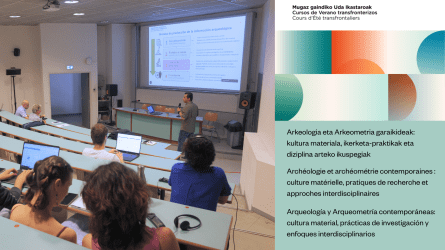
On 29 June, the ‘Arqueología y Arqueometría contemporáneas: cultura material, prácticas de investigación y enfoques interdisciplinarios’ [‘Contemporary Archaeology and Archaeometry: Tangible Culture, Research Practices and Interdisciplinary Approaches’] course will open the programme. It will analyse the meeting point between archaeology and archaeometry, by delving further into the traditional interpretation of the tangible culture and into the principles of open science.
On 30 June, ‘Euskal Herria país de acogida. Reto y oportunidad’ [The Basque Country as Host Country. Challenge and Opportunity] will analyse the impact of migration in the Basque Country and the challenges of reception policies from the perspective of civil society, institutions and the Basque Language.
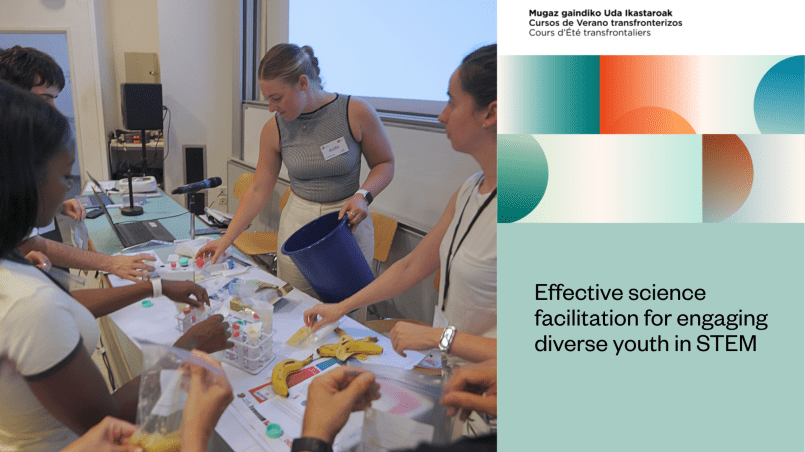
Two courses will be held on 1 July. On the one hand, ‘Facilitación científica efectiva para involucrar a jóvenes diversos en STEM’ [‘Effective Scientific Facilitation to Involve Diverse Young People in STEM’] will provide practical tools and methodologies for inclusive dissemination in the areas of science, technology, engineering and mathematics (STEM). On the other hand, ‘Lenguas minorizadas e inteligencia artificial’ [‘Minority Languages and Artificial Intelligence’] will consider the opportunities and challenges for developing minority languages in the Artificial Intelligence era, and present the results of the LINGUATEC-IA project.
On 2 July, the ‘Institucionalización y gobernanza de la Eurociudad’ [‘Institutionalisation and Governance of the Eurocity’] course will look at cross-border governance and the institutionalisation of the Eurocity. On that day, ‘De lo global a lo local: observando los discursos en torno a la revitalización’ [‘From Global to Local: Observing Discourse Around Revival’] will analyse the discourse around promoting the Basque Language and the existing attitudes in the French Basque Country.
Finally, two courses will be held on 3 July. ‘Diferentes dispositivos de formación en didáctica multilingüe’ [‘Different Training Devices in Multilingual Education’] will analyse models for multilingual education and teacher training in the HEZHI project. Furthermore, ‘El juego de la pelota y de pelota vasca: ¿un patrimonio material e inmaterial transfronterizo?’ [Jeu de Paume and Basque Pelota: A Cross-Border Tangible and Intangible Heritage?] will address the intangible and tangible heritage of Basque pelota from a cultural, social and historical perspective.
Enrolment open
Enrolment will be free and will remain open until the day of the courses.
Information and enrolment:
https://www.uik.eus/en/activities/program-cross-border-summer-courses