Inclusive Science Communication to Bring STEM Closer to Young People
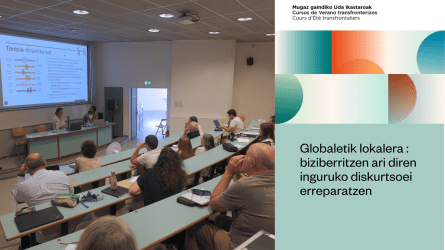
The Cité des Arts in Bayonne hosted the Cross-Border Summer Course "Effective Science Facilitation for Engaging Diverse Youth in STEM" on 1 July. Organised by EHU, the University of Bordeaux and the University of Galway, the course brought together researchers, educators and science communication professionals to explore how science can be made more accessible to an increasingly diverse youth population.

The aim of the course was to provide participants with the tools to communicate science in a more inclusive way and to inspire scientific vocations among young people who have traditionally had fewer opportunities to engage with STEM.
The course was built around a key idea: scientific work does not end in the laboratory—it also involves communicating knowledge effectively and making it accessible to society as a whole. Esther Blanco, Professor at the Faculty of Science and Technology of the EHU, emphasised that these communication skills are rarely included in university curricula and that this course offered participants a valuable opportunity to develop them. She also highlighted the experience gained by the University of Galway through its Cell Explorers programme, which has been running since 2012 and has become an international benchmark in inclusive science communication. The programme's methodologies formed the basis for much of the course content.
The Cell Explorers programme was one of the central themes of the day. Muriel Grenon, from the University of Galway, explained that the initiative trains university students to engage with children and teenagers—particularly those aged 10 to 13—through inclusive science activities that encourage meaningful conversations with researchers. The programme also aims to reach young people who would not normally have opportunities to engage with science, helping them to see themselves reflected in the field and to consider a future in STEM. As she noted, having relatable role models can make a real difference in helping young people feel that "science is for them too."
Karen Gaudin, from the University of Bordeaux, explained that the goal of the Cross-Border Summer Course was to offer participants a combination of theoretical foundations and practical activities focused on science communication. The training explored concepts such as science capital—the collection of experiences, knowledge and role models that shape people's relationship with science—and demonstrated how to design activities that help children and young people feel heard, build confidence in their abilities and recognise that science can also be part of their future.
Throughout the day, participants explored topics including science capital, the psychology of participation, the creation of inclusive STEM environments, communication skills and facilitation techniques through lectures and workshops led by specialists from European universities and research centres.
This Cross-Border Summer Course strengthened collaboration between European universities and highlighted a shared challenge: making science more accessible, participatory and inclusive while encouraging scientific aspirations among all young people, regardless of their background or previous experience.