The 45th Summer Courses to revolve around shared knowledge, cities and innovation

Between June and September, 133 summer courses and 29 workshops will be run, with San Sebastián, Bilbao, Bayonne and Vitoria-Gasteiz as the main centres
The programmes backed by the Basque Government’s Ministry of Science, Universities and Innovation and its Ministry of Education will be centre-stage
Under the tag line ‘You Think, Therefore We Are’, UIK is an open meeting point to share knowledge and to address society’s challenges
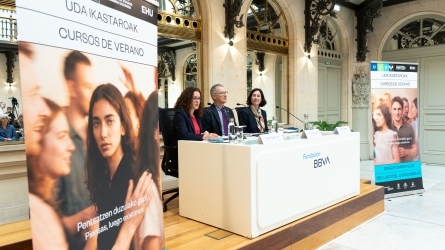
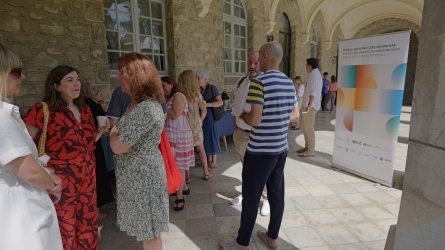
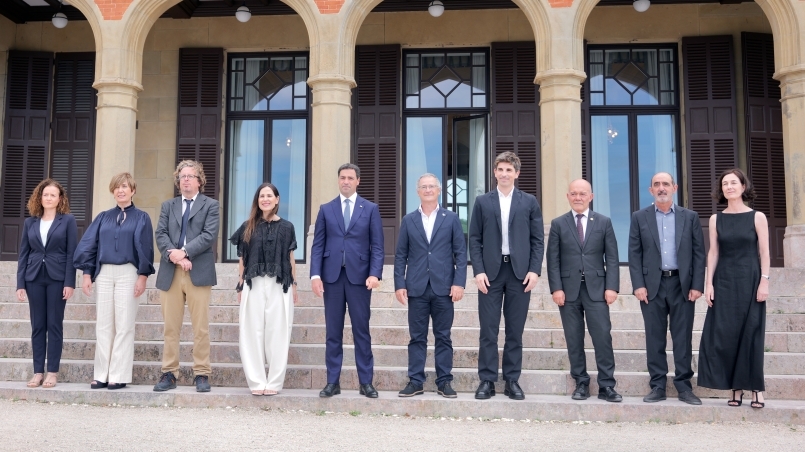
The 45th Summer Courses organised by the Summer Courses Foundation of the University of the Basque Country (UIK) have been presented today at the Miramar Palace in San Sebastián. During the presentation, the main contents of this year’s courses were unveiled, with special focus on the programmes backed by the Basque Government’s Ministry of Science, Universities and Innovation and its Ministry of Education.
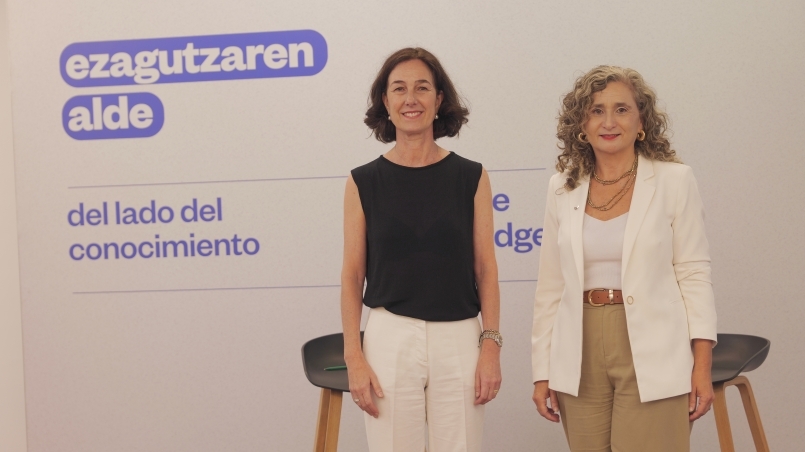
Joxerramon Bengoetxea, Rector of the University of the Basque Country (EHU) and Chair of the Board of the Summer Courses Foundation; Begoña Pedrosa, the Basque Government’s Minister for Education; Xabier Aizpurua, the Basque Government’s Deputy Minister for University Policy; and Idoia Otaegui, the Academic Director of the EHU Summer Courses, took part in the presentation.
The Summer Courses will be officially opened on 30 June
A total of 133 Summer Courses and 29 workshops are scheduled to be run from early June to the end of September. As regards the number of activities, San Sebastián, Bilbao, Bayonne and Vitoria-Gasteiz will be the main centres. In keeping with the aim to expand the territorial presence, the courses will also be held in other municipalities, including Aramaio, Ataun, Beasain, Bermeo, Gernika-Lumo, Irun, Lesaka, Oñati, Ordizia and Zaldibia.
Thanks to the experience accumulated over the years and the relationships built with institutions, professionals and stakeholders working in the field of knowledge, the Summer Courses have become a benchmark for the dissemination, debate and reflection around the main challenges of society.
This year’s programme offers a quality range of learning and from a pluralistic approach, with the goal of addressing today’s major issues.
Joxerramon Bengoetxea, the EHU Rector, stressed that ‘the Summer Courses bolster the public vocation of the university; it allows us to build and share knowledge with society – beyond the university itself – so that we can open up spaces together where to raise new questions and create collective responses; in these polarised times, they offer the space that thought needs’.
Strategic partnerships are fundamentally important for UIK. Proof of this is the unwavering backing of the Basque Government, Gipuzkoa Provincial Government, San Sebastián City Council and the BBVA Foundation, which guarantees the development and continuity of the project. During the presentation, special mention was made of the range of learning available thanks to the contribution of the Basque Government’s Ministry of Science, Universities and Innovation and its Ministry of Education.
As the Rector announced, the Lehendakari [Basque Premier] will officially open the Summer Courses in the Miramar Palace on 30 June. Daniel Innerarity, Professor Political Philosophy, Ikerbasque researcher at the EHU and director of the Democratic Governance Institute, will give the keynote speech: ‘El futuro de la democracia’ [‘The Future of Democracy’].
Education: training teachers and learning communities
The Basque Ministry of Education, in conjunction with UIK, is the driving force behind two main programmes to bolster the training and refresher courses for teachers: ‘Aprender para enseñar’ [‘Learning to Teach’] and ‘Ikasiz Hezi’ [‘Educate by Learning’].
‘Aprender para enseñar’ was launched in the year 2000 as training and refresher courses for education professionals. This year, 14 courses have been selected within the programme; they will all be accredited so that the teachers can obtain the respective certificate. There will be a reduced enrolment fee for Primary, Secondary, Upper Secondary and Vocational Education & Training teachers from the Basque Autonomous Community (BAC). The full range of learning is available on the UIK website: www.uik.eus, particularly in the section on this programme: https://www.uik.eus/es/cursos/programa-aprender-ensenar-gobierno-vasco
On the other hand, ‘Ikasiz Hezi’ is the in-service training plan for non-university teachers organised by the Basque Government’s Ministry of Education. This year, 9 centres have been selected within this programme, and the Basque Government will award grants to 20 teachers per Summer Course.
The areas covered in both programmes are related to the main challenges of today’s educational system: preventing suicide & mental health; skills assessment; working by subject areas in Secondary Education; gender identities; neurodiversity; screens and sexual education, governance of the publicly-run school; community practices; and transformative pedagogies.
Begoña Pedrosa, the Basque Minister for Education, stressed that ‘the UPV/EHU Summer Courses are a strategic tool to give impetus to improving the Basque education system. Offering teachers opportunities for reflection, refreshing skills and pooling new practices is fundamental to advance towards more transformative and inclusive education’.
Science, University and Innovation to address current challenges
The Basque Government’s Ministry of Science, Universities and Innovation provides general support for the Summer Courses of the University of the Basque Country (EHU), in order to drive and back the courses’ role in disseminating knowledge.
As part of this support, the Ministry specifically backs a series of courses. This year, those courses are in line with the five pillars of the updating of the recently approved Science, Technology & Innovation Plan – Highly Qualified Individuals; Cutting-Edge Science; Industrial Leadership & Competitiveness; Community & Innovation – along with the Innovation Lighthouses.
Thus, La mirada ética de la vulnerabilidad [The Ethical View of Vulnerability] will highlight the work on social intervention and care ethics, and will share methodologies to make decisions for when there is a conflict of values. This course is fully in line with the Social Determinants of Health lighthouse.
On the other hand, the Salud mental y tecnología [Mental Health and Technology] and Pleamar. La ola transformadora de la innovación en salud [High Tide. The transformative Wave of Health Innovation] courses are related to the Personalised and Precision Medicine lighthouse. These courses will analyse the links between health, technology and public innovation, with the spotlight on digital health, using data strategically, and person-centred care.
Continuing with the Innovation Lighthouses, there are two other courses: Menos corregir y más feedback en la era de la inteligencia artificial [Less Correcting and More Feedback in the Artificial Intelligence Era] and Adimen Artifiziala Hezkuntzan: kezkak eta formakuntza-beharra [Artificial Intelligence in Education: Concerns and Training Needs]. These courses focus on the Artificial Intelligence lighthouse, addressing the opportunities, risks and training needs caused by artificial intelligence entering the classroom.
Fostering Dialogue and Collaboration among Minority Language Educators: Basque, Occitan and Irish within our Teacher Academies will foster dialogue between academics, professional and institutions teaching minority languages, and rounds off this series of courses. Specifically, this theme can be linked with the Community pillar, one of the most important contributions of the Science, Technology and Innovation Plan, as it recognises the value of Basque and linguistic diversity in the Basque scientific and technological community.
In turn, the Ricardo Echepare Lecture – under the aegis of the Basque Ministry of Science, Universities and Innovation in this parliamentary term – will be held at the Miramar Palace in San Sebastián on 15 September. This year, Ana Zubiaga Elordieta will give the main lecture.
Zubiaga, Chair of Jakiunde and Professor of Genetics at EHU, will speak on Un solo planeta, una sola salud [One Single Planet, One Single Health]. She will also address aspects that come under the One Health Innovation Lighthouse.
According to Xabier Aizpurua, the Basque Deputy Minister for University Policy, ‘this programme will fully address, as part of the University of the Basque Country’s Summer Courses, the strategy and the strands of work that our ministry is developing in the area of science and innovation’.
Furthermore, the Deputy Minister pointed out that the El Autogobierno Vasco 90 años después [Basque Self-Government 90 Years on] course – an initiative of the Basque Government’s Ministry of Governance, the Digital Administration and Self-Government and its Ministry of Science, Universities and Innovation – will be held in July. During the course, the social, legal, political institutionalisation processes of Basque self-government during the 20th and 21st century will be analysed, and the participants will reflect on the evolution and bolstering of Basque self-government in recent decades.
‘You Think, Therefore We Exist’: an invitation for shared knowledge
UIK wants this year’s campaign to send out a simple but significant message: ideas, when they are shared, are not lost; they grow and are transformed. Knowledge becomes really meaningful when it is shared with other people, when it triggers new questions, and when it becomes a collective experience able to trigger new questions and forge new paths. We have thus reinterpreted the famous phase of Descartes for this year’s tag line: ‘You Think, Therefore We Are’.
To quote Idoia Otageui, the UIK Academic Director, ‘the Summer Courses are not only a range of learning; they are an ecosystem to share knowledge. Academia, institutions, professionals and citizens there have the opportunity to listen to each other, discuss and learn together’.
Year after year, the programme offers a wide range of learning for different audiences. Students of different ages, academics, scientists, the business community, professionals, representatives of the administration and people from many other spheres will gather there to share knowledge and reflect together.
An innovative and inclusive future based on care
The 2026 Summer Courses will offer an inclusive approach, with people and their living conditions at the centre. Care, mental health, social cohesion, community, equality, disability, ageing, innovation and culture will be some of the focal points of the programme.
There will be special emphasis on the courses related to care and wellbeing. La garantía de los cuidados basada en la igualdad de las personas y en los derechos humanos: su impacto en la organización social y en las políticas públicas [Guaranteeing Care Based on Equality and on Human Rights: Its Impact on Social Organisation and Public Policies], Desinstitucionalizar los cuidados en el contexto social actual: ¿cómo y cuándo? [De-institutionalising Care in the Current Social Context: How and When’?] and Relaciones, territorio y apoyos: cuidar y construir comunidad en Gipuzkoa [Relations, Territory and Support: Caring and Building Community in Gipuzkoa] ( TopaGune Course) will address new care models, rights, community and transformation of public policies.
As regards mental health and grief, several courses will offer a humanistic, social and professional perspective. They include Salud mental del personal médico: clave para el bienestar social [Mental Health of Medical Staff: Fundamental for Social Wellbeing], Eragintza: 35 años de compromiso con la inserción laboral de personas con problemas de salud mental [Eragintza: 35 Years’ Commitment to the Employability of People with Mental Health Problems] , Visibilizando el duelo gestacional, perinatal y neonatal [Highlighting Neonatal, Perinatal and Gestational Grief] and Escuchar, comprender, actuar: claves para afrontar el suicidio [Listening, Understanding, Acting: Pointers to Deal with Suicide].
The links between communication health, among other aspects, will also be addressed in the TopaGune Course: Comunicación que sana: cómo evitar conflictos y mejorar la seguridad de la persona [Communication that Heals: How to Avoid Conflicts and Improve Individual Safety]. This course will analyse the strength of the narrative, humanist medicine and professional-patient communication.
There will also be a focus on striving for a more inclusive society. Inclusión, derechos y apoyos de las personas con discapacidad [Inclusion, Rights and Supporting People with Disabilities] will analyse the rights, support and inclusion of people with disabilities in the context of the 20th anniversary of the New York Convention. In turn Educación sexual y pantallas: desafíos, oportunidades y propuestas [Sexual Education and Screens: Challenges, Opportunities and Proposals] will consider the influence of the digital environments on identities, relationships and sexual education in childhood and adolescence.
In the field of Culture and Art, the Commemorative Ceremony of the 25 Orfeón Donostiarra-EHU Award will be held at the Miramar Palace on 10 July. The ceremony will recognise the research in the education, creation and promotion of choral music, and will end with a performance by Orfeón Donostiarra.
5th Cross-Border Summer Courses
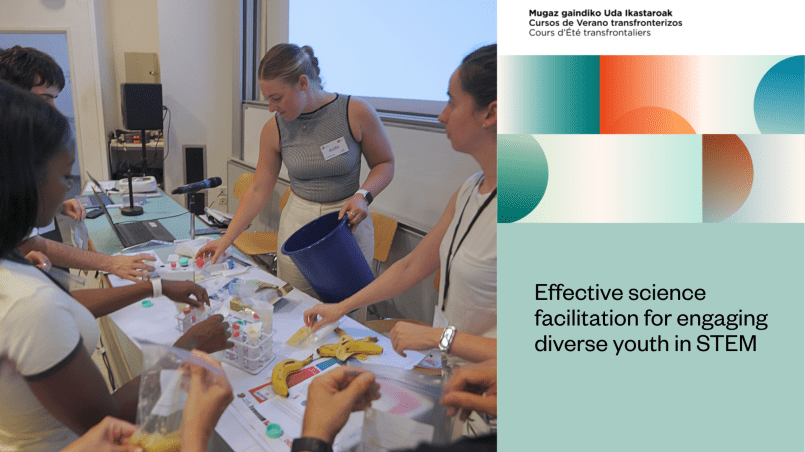
The 5th Cross-Border Summer Courses will be held in Bayonne from 29 June to 3 July 2026. The range of learning, consisting of eight courses, will be free and will focus on cross-border cooperation, multilingualism and mainstreaming knowledge.
This programme bolsters the open and interterritorial nature of UIK, by promoting the different situations of the Greater Basque Country and cross-border cultural, social and academic cooperation.
Innovative participation and methodologies
The majority of the courses will be in-person and, in many cases, will also be live streamed online. Furthermore, innovative and participatory methodologies will be used in 43 summer courses, apart from the usual formats.
With that in mind, six courses are part of the TopaGune project, rolled out with the support of Gipuzkoa Provincial Government. The TopaGune courses are well attended; the UIK academic management, the courses managers and facilitators are involved in designing them, in order to develop effective reflection, discussion and co-creation dynamics.
Enrolment open
Enrolment is open and people have until the start of each course to sign up. Full information and registration available at www.uik.eus
As regards special rates, there are different types of discounts for different groups, both when enrolling on the courses and for accommodation. The specific datasheet for each activity should be consulted, along with the general information.
There is a special offer for young people aged 18 to 25 to encourage them to sign up for the Summer Courses: they will only have to pay €25 on the majority of courses.