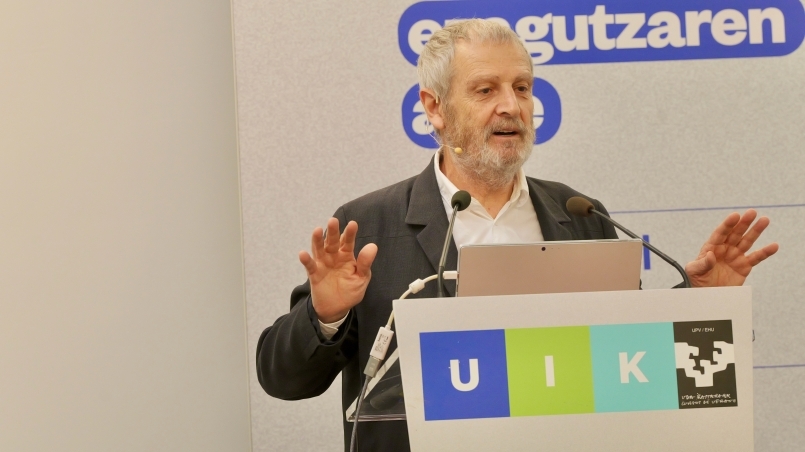
Ana Mª Vicedo: ‘There are ever more cases of climate litigation and many more bridges of communication between science and different areas of the law’
In 2024, the European Court of Human Rights found in favour of KlimaSeniorinnen Schweiz, a group of Swiss women aged 65 and over, in the case they brought against the Swiss government, accusing the latter of failing to act against climate change. The group argued that that the country’s government had not adopted sufficient measures to offset climate change, thus violating the human rights of older women, a group particularly vulnerable to heat waves.

The path to justice was hard and long. The group was set up in August 2016. They filed complaints with different Swiss authorities between 2016 and 2017, but there were all dismissed. Between 2017 and 2019, they subsequently lodged claims with the Administrative Court and the Supreme Court, which were also dismissed. The group then decided to take their case to the European Court of Human Rights (ECHR) in 2021. The case was referred to the Grand Chamber of the ECHR in April 2022 and was heard in March 2023.
The scientific evidence on the impact of climate change on health was a crucial aspect in these legal proceedings. Ana María Vicedo Cabrera, an environmental epidemiologist and professor at Berne University, headed a ‘third-party intervention’ along with other researchers. This legal mechanism allows experts to prepare and submit to the Court objective documents summarising the relevant scientific evidence for the case.
During her talk at the Donostia Sustainability Forum, Ana Mª Vicendo explained that the evidence focused on how climate change is leading to an increase in record-breaking extreme events, for example the summer temperatures in Europe. The Vicedo team used models to show the urgency of the situation. An extreme heat event – such as the Paris heatwave in 2023 – used to be exceptional and now occurs three times more frequently in today’s climate. Such events will become the norm in future scenarios with temperatures of 1.5 ºC to 2 ºC above the pre-industrial era.
The silent killer
Vicedo explained that heat is a ‘silent killer’, whose effects go much further than dehydration or heat stroke. High temperatures are particularly dangerous for elderly people with a history of illness, as they worsen pre-existing conditions, resulting in hospitalisations or deaths due to heart attacks, strokes or respiratory distress. Women also seem more vulnerable to heat – particularly older ones –as the result of menopause-related physiological changes that limit the ability to control the body’s temperature and as they usually do more physical activity as they are in charge of household tasks and caring.
The success of climate litigation requires the full chain of causation to be mapped: from greenhouse gas emissions from human activity to global warming, extreme events and, finally, the specific impacts on health. Globally, it has been estimated that 37% of heat-related deaths during the last three decades could be attributed to anthropogenic climate change.
The key evidence for the Swiss case came from a study on heat-related mortality in the summer of 2022 in this country conducted by the research group at Berne University, of which Ana Mª Vicedo is a member. The study estimated that there had been up to three times more heat-related deaths that summer, and that up to 60% of those deaths could have been prevented if climate change were not a factor. As Ana Mª Vicedo pointed out, the most important aspect was that up to 60% of such deaths occurred in women over 65. These figures were fundamental in the Court.
A historic ruling
In April 2024, the ECHR issued its ruling, in which it considered that there was clear evidence that the Swiss State had violated the human rights of this group of women. The Court urged the Swiss government to roll out more ambitious mitigation policies. This was the first case where the ECHR found against a State for climate inaction, basing its ruling on the violation of human rights.
Even though the ECHR has no direct legal standing within Switzerland, the ruling had a huge symbolic impact; it was even considered a ‘national embarrassment’, to quote Ana Mª Vicedo, given that the Swiss courts had previously dismissed the case.
After the ruling, the Council of Europe was tasked with overseeing the proceedings. Switzerland had to produce a plan to meet the goal of mitigating its greenhouse gas emissions. The Swiss government initially submitted a document defending its position, but it was rejected. It subsequently produced a new plan that – to the surprise of many – was accepted by the Council of Europe.
As the epidemiologist explained, that acceptance prompted criticism as – according to the women’s lawyer – the Swiss government used different benchmark values and numbers from those established by international studies. Even though the go-ahead by the committee did not detract from the importance of the proceedings, it was disappointing and the fight continues to show that this plan falls short.
Science coming together with legislation
The historic ruling against Switzerland has set an important precedent and has acted as a catalyst for future legal actions. ‘We are now seeing increasingly more cases of climate litigation’, stressed the speaker. Using epidemiology to establish the ‘chain of causation’ connecting emissions with extreme events and, ultimately, with the ‘health impacts’ (such as heat-related death), is seen as a very powerful argument for the future.
The KlimaSeniorinnen case has highlighted the pressing need to strengthen the bridges of communication between science and the law. Experts – acting objectively – can provide newer and stronger evidence that policy makers needed to take informed decisions. ‘We are not activists. Our role within the process is as experts. We provide documents based on the existing evidence’.
According to Ana Mª Vicedo, ‘We are now seeing increasingly more cases of climate litigation, and, above all, how many bridges of communications have been built between sciences and the different areas of the Law’. The success of climate litigation – such as that achieved by the older Swiss women – shows that science, epidemiology and law can unite to create more ambitious and effective mitigation policies seeking the common good.