Mª José Sanz: ‘Ten years on from the Paris Agreement, multilateralism at the COP continues to be alive and progressing’
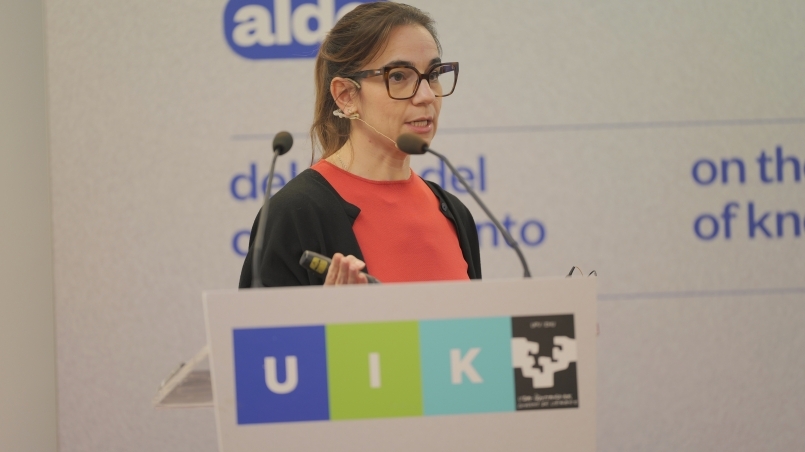
The recent Conference of the Parties (COP30), held in Belem (Brazil) on the 10th anniversary of the Paris Agreement, ended with a series of decisions that show the persistence of the multilateral process defining these climate summits, despite the desired ambition not being achieved. At the Donostia Sustainability Forum, Mª José Sanz, the Basque Centre for Climate Change (BC3), explained that progress had been made regarding aspects such as climate finance and protecting tropical forests, in spite of the extremely complex geopolitical context, characterised by a global ‘polycrisis’.

The conference sought to align climate commitments with the target of limiting warming to 1.5 degrees, to roll out a global finance strategy, and to bolster adaptation and climate justice. The event in the Amazon stressed the key role of forests in fighting climate change. Mª José Sanz stressed that the volatility in Ukraine and the Middle East and the growing tension in East Asia have led to greater spending on defence, which could be to the detriment of investment in the climate transition. Furthermore, the energy crisis linked to the geopolitical situation has signalled a return to the use of fossil fuels in some economies; however, paradoxically, it has driven the growth of renewables as a source of energy security.
Despite this panorama, the COP process – which is based on consensus among 198 states – continues to be vital, as the BC3 scientific director explained. This mechanism – even though slow and inclined to create ‘Frankenstein’ texts where everybody is a winner and a loser – guarantees that smaller economies, such as the tiny Pacific islands, are heard and which would otherwise by ignored in a voting process.
Specific Advances
COP30 agreed a package of measures focused on increasing funding and speeding up the roll out of the Paris Agreement. This includes the setting up of an adaptation fund, which is one of the great successes of COP30. The new global finance goal envisages $120 billion a year earmarked for adaptation, which is 50% of the total target of mobilising $300 billion a year. Furthermore, progress was made in the complex task of defining measurable indicators to assess the effectiveness of the adaptation measures.
Mª José Sanz also highlighted the setting up of the Tropical Forest Forever Facility. This fund is different from the traditional mechanisms as it is explicitly focused on conserving existing forests, not only on reducing deforestation. The goal is to mobilise $125 million to protect over 1 billion hectares in more than 70 developing countries with tropical forests. Several countries, including Germany, Norway, Portugal and France, have already committed to make contributions. In tandem, 14 countries undertook to secure the land rights of indigenous populations and local communities across 80 million hectares by 2030; this addresses the issue of the lack of legitimate owners, one of the main problems leading to deforestation.
Bolstering technical assistance and knowledge sharing was likewise agreed to ensure a just transition; internal trade was also discussed, boosted by the carbon border adjustment mechanism rolled out by the European Union. A new work area has been set up to address the frictions generated by such measures and other commercial issues on the climate agenda.
Sanz then moved on to the agreeing of the new Gender Action Plan for the next 10 years, which includes the use of disaggregated data, gender analysis for decision making, and integrating the gender perspective in national climate policies.
Unresolved Issues: fossil fuels and NDCs
Despite the progress made, COP30 was considered by certain members of the media to be a ‘failure’ given the lack of key decisions. The greatest deception was the lack of an explicit commitment to completely phase out fossil fuels within a specific period. This issue, considered to be the ‘elephant in the room’, continues to be unresolved.
As regards climate ambition, the unveiling of the second round of National Determined Contributions (NDCs) did not meet expectations. Only 121 out of the 198 countries submitted new NDCs, meaning there are 78 countries without established targets, accounting for over a quarter of global emissions. They also failed to agree on a specific roadmap to eliminate global deforestation at a specific date.
Climate science called into question
A ‘relatively recent’ and concerning phenomenon is the attempt by some players, driven by the geopolitical context, to undermine the scientific evidence that endorses climate action. This attempt to chip away at the science can be clearly seen by the absence of the United States on key scientific panels (IPCC) and the dismantling of part of the research applied in that country, creating a vacuum that ‘Europe is trying to fill’, as Mª José Sanz pointed out.
The scientific community must be aware of the need for its findings to be disseminated rigorously, by managing uncertainty so as not be accused of exaggeration, and reaching out to citizens to generate the necessary dialogue and trust.