Salvador Rueda, creator of the superblocks: ‘Just reducing the vehicles on the road y 15% will free up 70% of space’
The current urban model is facing a major challenge. Cities are not only the main climate change scenarios, but are also major greenhouse gas emitters. The urban ecologist Salvador Rueda, President and Director of the Urban and Territorial Ecology Foundation, introduced the ecosystemic urbanism concept, which puts forward a comprehensive model designed to transform cities into resilient climate change scenarios and to return the public space to citizens.

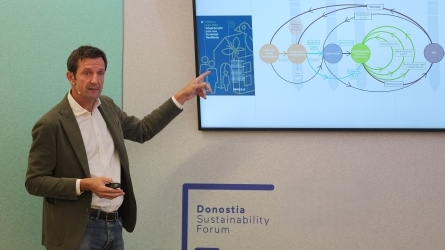
The superblock concept, the ‘cell’ or basic unit of a new urban planning model designed for 21st century cities, is its main expression. At the Donostia Sustainability Forum, Salvador Rueda stressed that the goal is to restore nature to the city as an adaptation and survival strategy to mitigate heat waves and risks of flooding.
The fundamental key for nature to return to the city lies in changing the mobility model. According to Rueda, the current situation cannot be reversed if streets mainly continue to be occupied by road traffic or parked vehicles. The superblock model proposes redesigning the mobility networks to free up large percentages of the public thoroughfare. The city is thus organised into two levels: The outer roads of each superblock are used for through traffic, goods and public transport, connecting the different points of the city, while the inner space is reserved for residents and local services, with a speed limit of 10 km/h.
‘The superblock model allows us to practically change everything without changing anything; merely redesigning the networks radically alters the cities,’ explained the Catalan ecologist. In the areas of Barcelona where this model has been rolled out, for example, 2,500 pedestrian priority streets have been created, releasing nearly 7 million square metres. The efficiency of the model is astounding, added Salvador Rueda, as only cutting road traffic by 15% can free up to 70% of the public space. In the case of Barcelona, traffic has already been reduced by 25%, meaning that this system can be immediately rolled out on a large scale.
A European mandate
The pressing need to transform the urban environment now has the backing of a mandatory regulation: Regulation 2024/1991 of the European Parliament on nature restoration. This document establishes that cities must ensure that there is no net loss of green space and tree canopy cover by 31 December 2030, compared to 2024. From 2031 onwards, the regulation requires an increasing trend of urban canopy cover until satisfactory levels have been achieved. Rueda’s ecosystemic urbanism is presented as a methodological tool to design the strategies to allow those requirements to be met.
As the person overseeing the mobility plan implemented in Vitoria-Gasteiz, Salvador Rueda explained that the number of avenue trees in this city has increased from 47,000 to 80,000, which is proof that transformation is possible and successful. Vitoria implemented a radical change to its public transport network in October 2009, dropping from 18 bus lines to only 7. This redesign, based on a more efficient orthogonal network, has meant closer stops and a more frequent service for citizens. Consequently, the percentage of new users rose by over 100% before the pandemic. Furthermore, the price of roadside parking was tripled in order to reduce traffic and the flow of vehicles has fallen in an orderly manner.
Nature restoration: Beyond aesthetics
Rueda warned that effective nature restoration to adapt to climate changes requires a scientific and systemic, and not merely visual approach. Nature acts as the best ‘cooling machine’ thanks to evapotranspiration. As water evaporates, energy is absorbed from the atmosphere and cools it naturally. To achieve this, ecosystemic urbanism proposes measures such as creating a double greenery system, which creates a layer of vegetation on the surface and another at a height to maximise the biodiversity and thermal control; and permeable soils, which allow oxygen to reach the roots and rain water to filter in. This dramatically reduces the risk of flooding and allows the aquifers to fill instead of swamping the waste-water treatment plants.
From ‘Pedestrian’ to ‘Citizen’
Salvador Rueda explained that pedestrians going from one place to another continue to be a ‘means of transport’ and that his city model has ‘the citizen’ in mind. The public space freed up inside the superblocks must be used, in his opinion, for playing, sharing, enjoying art or just being. Furthermore, he added, the evidence shows that such interventions are economic drivers: commercial activity has increased by between 15% and 60% in the transformed areas.
Impact on health
Deploying this model not only meets environmental but also public health criteria. In Barcelona, it is estimated that superblocks being fully rolled out would avoid nearly 700 premature deaths a year, thousands of asthma attacks and bronchitis, and would save €1.7 billion in health costs.